
The physical problem
A barrier designed for dry ground may not work in the same way on the seabed. Water couples to the soil and supports different wave mechanisms near the interface.
MSc candidate · Submerged vibration barriers
Why does a barrier behave differently when the ground is underwater?
Isadora studies how water changes ground-wave propagation and the performance of walls intended to reduce seabed vibration.
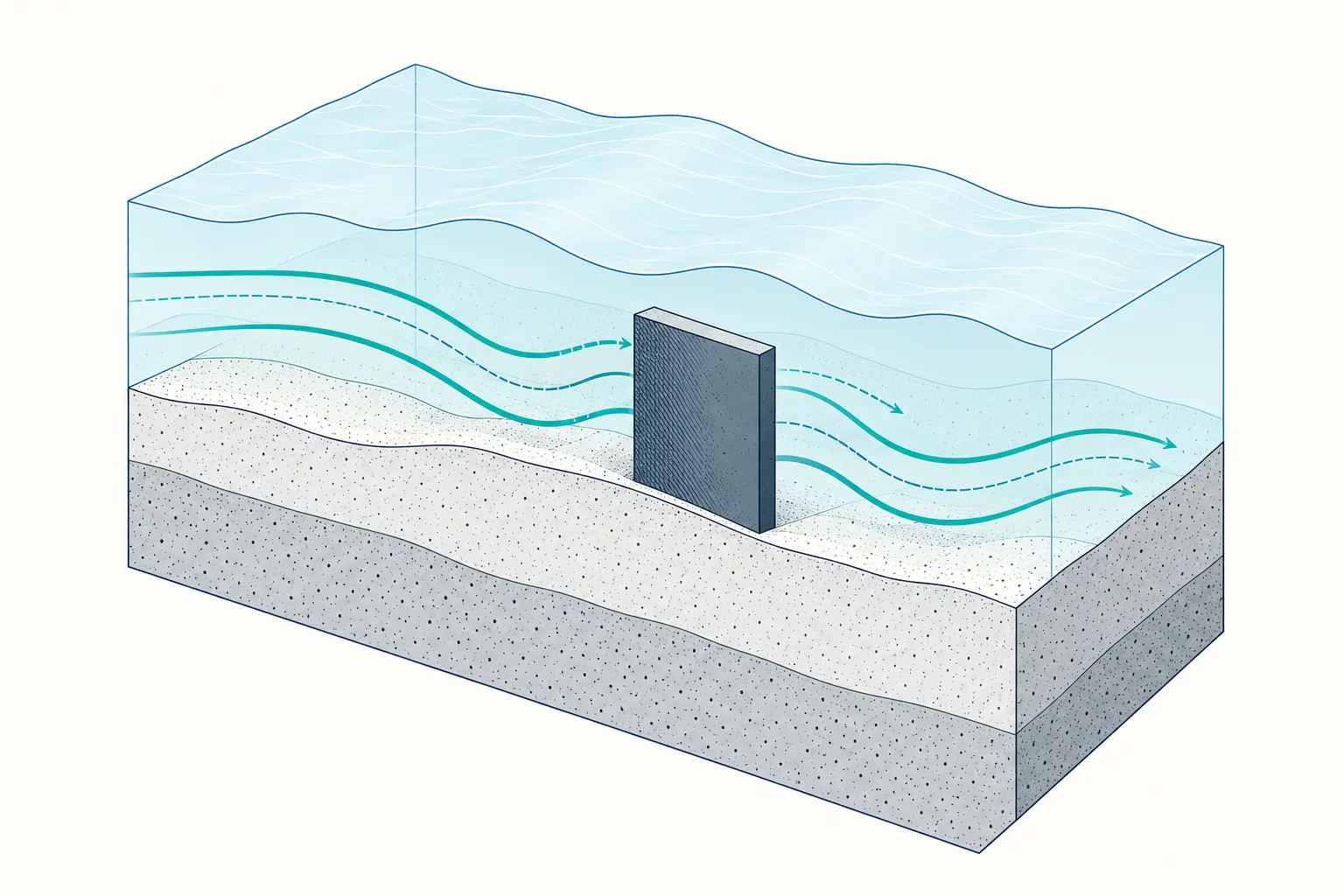
A barrier designed for dry ground may not work in the same way on the seabed. Water couples to the soil and supports different wave mechanisms near the interface.
Her current project compares dry and submerged systems, follows the transition from Rayleigh-dominated to Scholte-type interface waves, and studies how wall mass, stiffness and geometry affect attenuation.
Understanding the coupled physics is essential before barriers can be designed for offshore construction and other vibration-sensitive marine settings.
Research evidence
Explore published studies, conference contributions and ongoing investigations.
Conference paper
A carefully calibrated absorbing domain makes it possible to separate genuine wall-induced attenuation from reflections generated by the edge of the numerical model.
COBEM proceedingsWork in progress
The new model is being structured around a controlled density continuation from air-like to water-like conditions so that the physical transition can be observed instead of inferred from two disconnected cases.