STFMi · IFPE

Sistemas Termo-fluido-mecânicos Inteligentes

Instituto Federal de Pernambuco · collaboration with Unicamp

With Gustavo Leite, Januário Vieira and Paulo Kurka, we investigate how vehicle mass distribution and suspension affect passenger motion.

IFPE: Gustavo Leite and Januário Vieira.
Unicamp: Paulo Kurka and our SSI Lab team.

Follow STFMi on Instagram
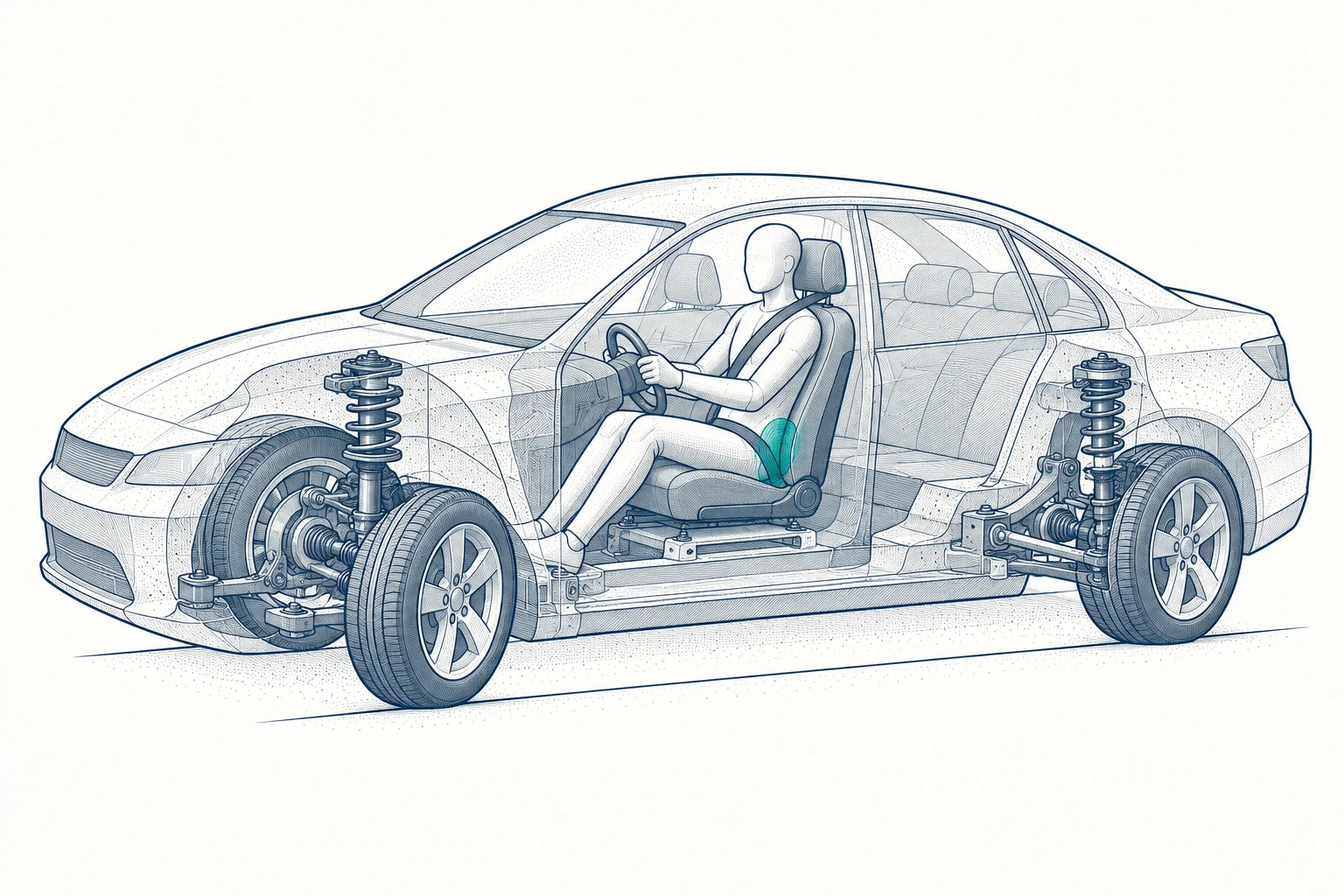
Conceptual cutaway of a passenger car, showing its front and rear suspension and the seated passenger as parts of a coupled mechanical system.
The vehicle and its passenger respond together to acceleration and braking. Conceptual illustration of the system we study.

Why can a car that pitches less still move its passengers more?

When a car accelerates or brakes, its body tilts and its passengers move with it. Changing where the vehicle’s mass sits changes both motions, sometimes in different directions. Our collaboration with Gustavo Leite and Januário Vieira at IFPE, and Paulo Kurka at Unicamp, combines vehicle dynamics, vibration analysis and computational modelling to understand this interaction. We study the vehicle and passenger as one coupled mechanical system.

Mass distribution and suspension

We vary mass, centre-of-gravity height and resistance to pitching, then examine how the suspension changes their effects. This helps us distinguish competing mechanisms in combustion-like and battery-electric-like configurations.

Motion reaching the passenger

We follow the motion from vehicle acceleration and body rotation to an observation point at head height. The frequency and timing of those contributions matter as much as their size.

Models, signals and verification

We connect mechanical modelling with expertise in vibration measurement and signal analysis. Component benchmarks and independent numerical checks help us identify what the model can reliably explain.

Working together.

Gustavo Leite

IFPE · STFMi

Mechanical systems, vibration measurement and signal analysis.

Januário Vieira

IFPE

Vehicle dynamics and the formulation and review of the mechanical model.

Paulo Kurka

FEM · Unicamp

Multibody dynamics, vibration and vehicle–passenger interaction.

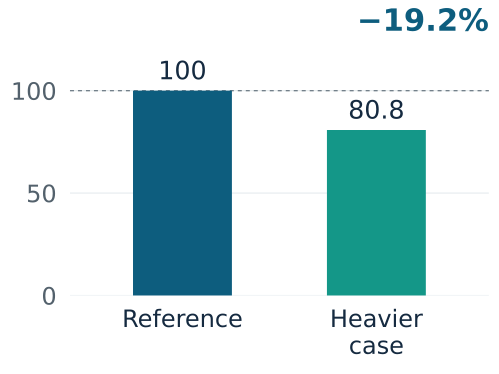
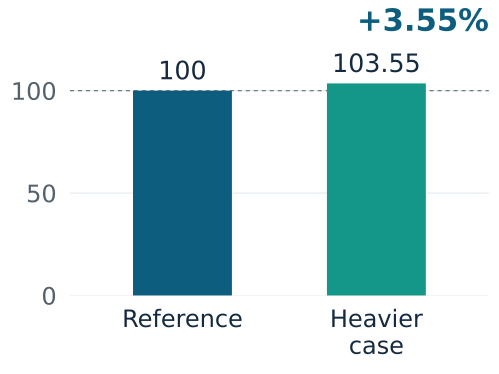
Less body pitch. More passenger motion.

In one controlled comparison, the heavier, lower-centre-of-gravity configuration pitches less, yet produces slightly more acceleration at head height. The two measures tell different parts of the story.

Peak body-pitch response

With the reference indexed to 100, peak body-pitch response falls to 80.8 in the heavier case: a decrease of 19.2 percent.
The vehicle body tilts less in response to the prescribed acceleration.

Passenger acceleration gain

With the reference indexed to 100, head-height acceleration gain rises to 103.55 in the heavier case: an increase of 3.55 percent over a flat 0.5–2 hertz input spectrum.
The overall, root-mean-square acceleration at the model’s head-height point increases over the selected frequency band.

Each measure is normalized to its own reference value of 100. Comparison: a 1,600 kg combustion-like reference and a 2,000 kg battery-electric-like case, with suspension rates scaled to axle mass. Passenger acceleration gain uses a flat input spectrum from 0.5 to 2 Hz.

Start with the whole system

A lower centre of gravity reduces one source of pitching. But changing mass distribution also changes which frequencies the vehicle responds to most strongly.

Follow the motion

The passenger receives both forward acceleration and rotation. In this example, the change in inertia shifts the response towards the assigned passenger mode, offsetting the benefit of less body pitch.

Check the comparison

Keeping the springs and dampers fixed changes the balance: the heavier case’s passenger gain becomes 2.20% lower. Our ongoing work maps when and why this ordering reverses.

These are preliminary results for constructed model configurations. They describe mechanical motion, rather than measured comfort or the performance of specific production cars.

From vehicle labels to mechanical explanations.

We are preparing Mass distribution and passenger motion: a parametric view of ICE-like and BEV-like vehicles. The study uses response maps and controlled comparisons to explain how mass, centre-of-gravity height, inertia and suspension interact.

The aim is to understand the mechanisms behind passenger motion and the conditions under which a comparison changes.

Josué Labaki, Januário Leal de Moraes Vieira, Gustavo de Novaes Pires Leite and Paulo Roberto Gardel Kurka. Manuscript in preparation; selected result from the September 2026 draft.